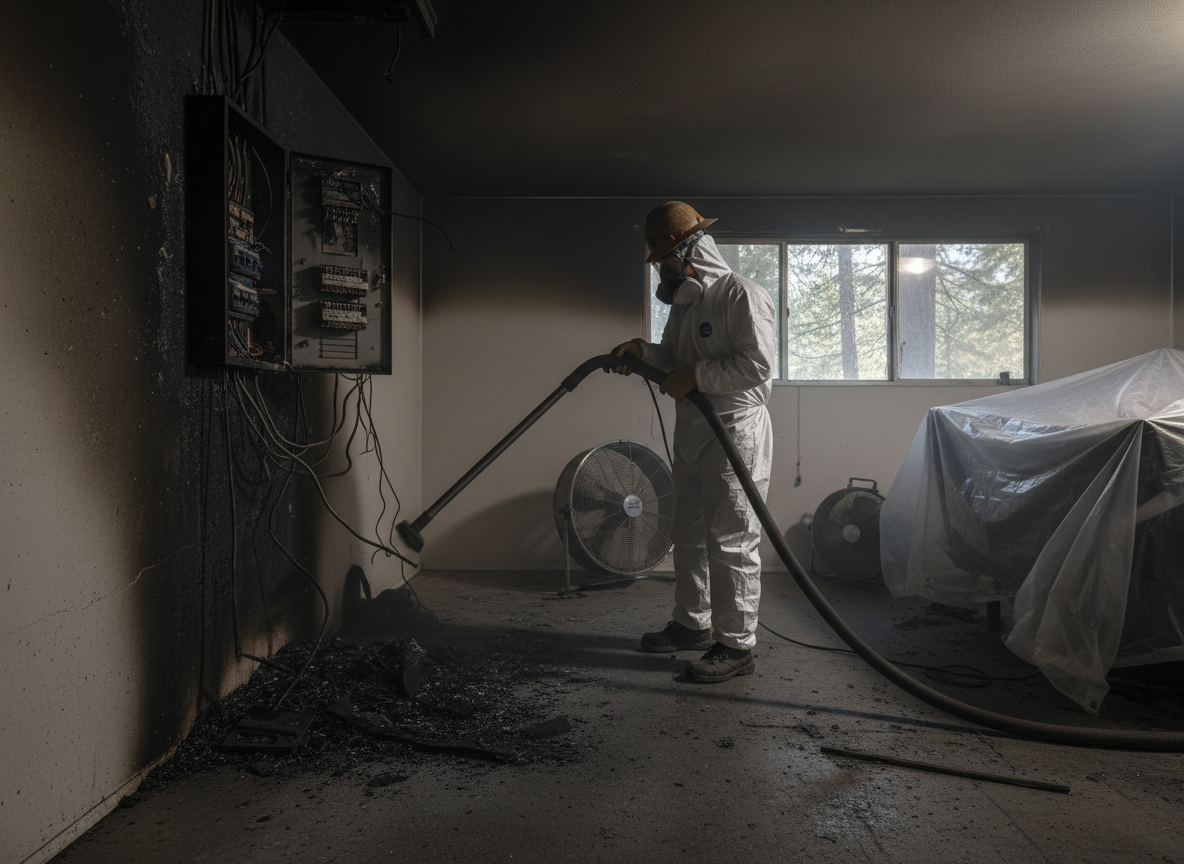
Electrical fires in Cedar Glen often start in older cabin wiring where cold winter temperatures cause insulation to contract and crack over time. Crews begin by isolating circuits at the main panel before removing charred Romex and knob-and-tube remnants that can hide behind knotty pine walls common in homes near Hook Creek Road. Soot from these fires carries conductive carbon that can re-ignite if not fully extracted from attic insulation and crawl spaces.
Mountain terrain around Lake Arrowhead creates access challenges after storms, so equipment must be staged at the 29125 Hook Creek Rd base for quick deployment. Warm summer afternoons increase ozone off-gassing from melted plastics, requiring negative-air machines with carbon filters to protect crews working in confined roof cavities. Hidden damage frequently extends along shared walls in duplexes built on steep slopes where fire travels upward through chaseways.
San Bernardino County building codes require permits for any re-wiring after an electrical fire, and inspectors check for proper AFCI protection in bedrooms. Restoration teams document every junction box opened and replace only the damaged sections rather than entire runs when possible, keeping costs lower for owners of 1960s-era A-frame cabins.
Post-cleanup verification includes thermal imaging to confirm no residual heat in outlet boxes and particle testing to verify soot levels meet clearance standards before drywall replacement begins.
Technician insight
In Cedar Glen, the thing that catches most people out with Electrical fire cleanup is how winter freezes push mice into attics chewing through old cloth-insulated wiring in cabins built before 1970, letting fire travel along shared rafters into the neighbor's unit before anyone smells smoke.
Hidden Attic Wiring Fire Near Lake Arrowhead
A cold snap caused a short in a 1962 cabin's knob-and-tube circuit. We found melted wire running under blown-in insulation that had carried soot into the living room HVAC. We isolated the run, removed the affected wiring and insulation, then cleaned and sealed the ductwork. The home passed county inspection and reopened within five days.
How it works
- 1
Initial Safety Assessment
Technicians arrive 24/7, shut off power at the meter, and test for live circuits while noting smoke migration paths through the cedar-shingled roof structures typical in Cedar Glen.
- 2
Source Removal
All charred wiring, outlets and junction boxes are cut out and bagged to prevent carbon tracking along remaining conductors.
- 3
Soot Extraction
HEPA vacuums and chemical sponges remove conductive residue from rafters, insulation and HVAC registers before deodorization begins.
- 4
Clearance Testing
Thermal scans and surface sampling confirm no remaining hazards, then a written report is prepared for county permit submission.
Pricing
Upfront written quotes provided after on-site inspection; scope depends on wiring age and smoke travel distance.