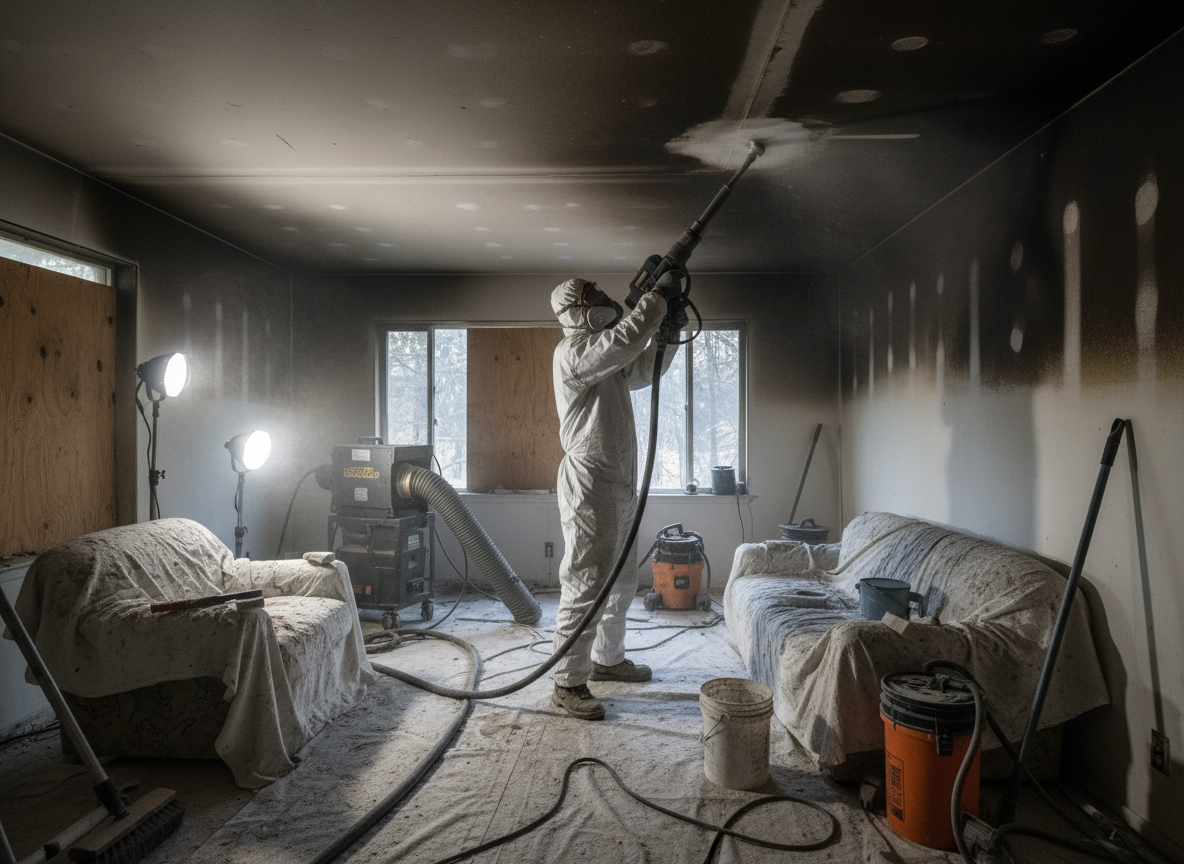
Cedar Glen sits in the San Bernardino Mountains where cold winter nights and warm summer days create constant expansion and contraction in older cabin walls and ceilings. Smoke from structure fires or wood stoves travels through those gaps and settles into the fibrous insulation and tongue-and-groove paneling common in homes built before the 1980s. Standard surface cleaning leaves residues that reappear when temperatures drop and humidity rises near Lake Arrowhead. Technicians must use air scrubbers with activated carbon and hydroxyl generators sized for the square footage while monitoring dew points to avoid driving moisture deeper into the materials.
Mountain terrain around Hook Creek Road means many properties have limited access and shared wells, so water-based cleaning methods must be measured carefully to prevent runoff or septic overload. Smoke often penetrates HVAC ductwork routed through crawl spaces that sit directly on native soil; those ducts require negative-air isolation before any cleaning begins. Homeowners frequently attempt to air out the house during the dry summer months, but the fine soot particles simply migrate to cooler wall cavities and reappear with the first autumn inversion layer.
San Bernardino County building codes require documentation of all affected cavities before drywall can be replaced after smoke events. Crews photograph and log every layer removed so inspectors can verify that no hidden residue remains near electrical boxes or plumbing penetrations. Because many Cedar Glen homes use propane or pellet stoves, alkaline residues from those fuels react differently with cedar and pine finishes than residues from structural fires, requiring pH-specific neutralizers rather than one-size-fits-all solutions.
Technician insight
In Cedar Glen the thing that catches most people out with smoke damage restoration is how the cold winters pull smoke particles deep into the loose-fill insulation of pre-1970s cabins along Hook Creek Road; once temperatures swing, the odor returns unless the cavities are opened and thermally fogged.
Wood-Stove Smoke Migration in Cedar Glen Cabin
A homeowner near Lake Arrowhead noticed persistent odor after repeated wood-stove use. Inspection found smoke had traveled through unsealed chaseways into the attic insulation. Crews isolated the attic, removed contaminated insulation, cleaned the chase, and applied thermal fogging. The home passed clearance testing and no odor returned during the following winter.
How it works
- 1
Initial Assessment
Technicians inspect every room, attic, and crawl space to map smoke migration paths through the specific construction details found in Cedar Glen cabins.
- 2
Containment and Air Management
Negative pressure zones are established using HEPA and carbon filtration to prevent cross-contamination between living areas and unaffected sections of the home.
- 3
Source Removal and Cleaning
Affected surfaces receive dry cleaning followed by pH-adjusted washes; porous materials that cannot be restored are removed and logged for insurance.
- 4
Odor Neutralization and Final Clearance
Thermal fogging or hydroxyl treatment addresses embedded odors, followed by third-party air sampling before the home is returned to the owner.
Pricing
Cost depends on square footage affected, depth of smoke penetration into insulation and cavities, and whether HVAC systems require full cleaning.