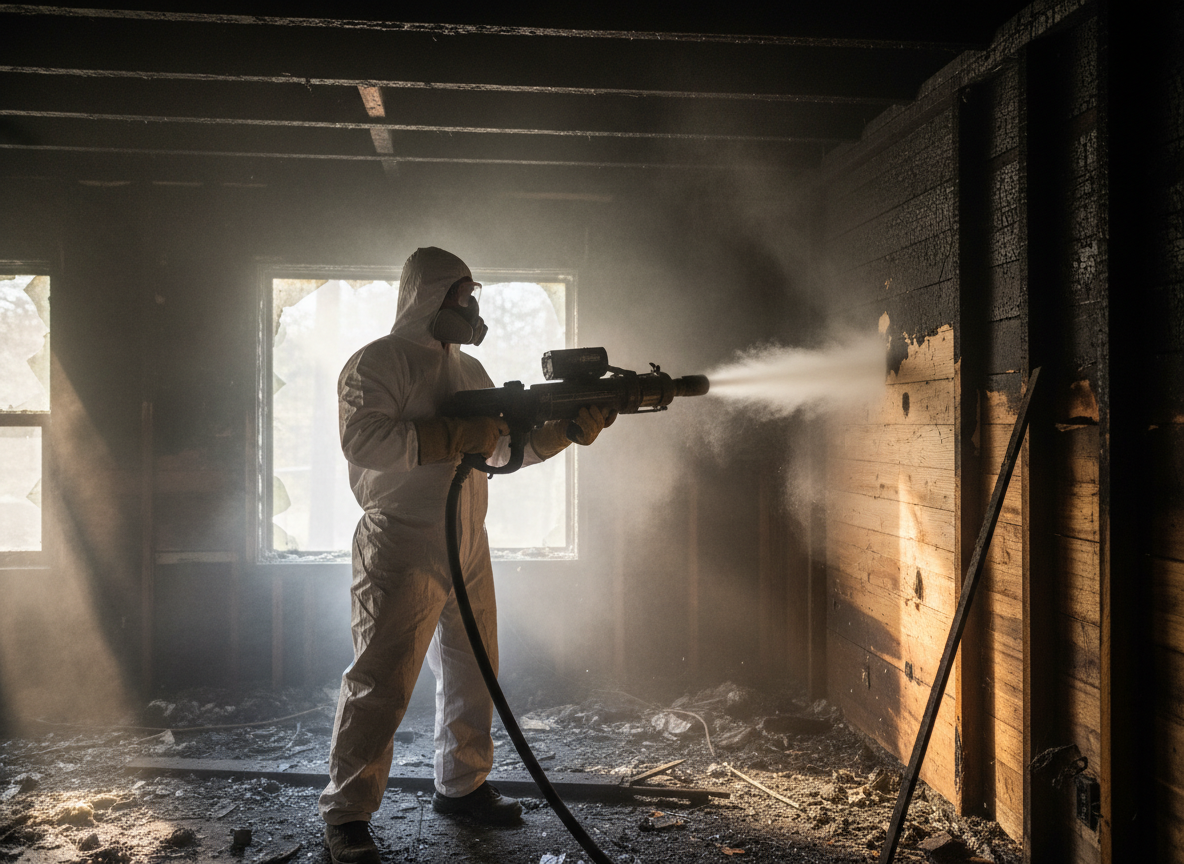
In Cedar Glen's mountain setting, smoke from fires travels through forested terrain and settles into the older cabin-style homes common throughout the area. Warm summer days followed by cold winter nights cause rapid temperature swings that drive smoke particles deeper into drywall, insulation, and attic spaces. Porous materials like wood paneling and carpet padding retain odors long after visible soot is removed, requiring specialized cleaners and negative air machines to prevent recontamination once heating systems kick on.
Homes near Lake Arrowhead often feature older construction with limited ventilation and shared HVAC ducts that spread smoke between rooms and even neighboring properties. Standard household cleaning fails here because alkaline residues from burned vegetation etch into surfaces and corrode metal fixtures. Technicians must test pH levels on multiple substrates and use HEPA filtration during every phase to protect indoor air quality in these tightly sealed mountain structures.
Terrain around Hook Creek Road creates access challenges after fires, with steep driveways and narrow roads limiting equipment staging. Smoke remediation crews account for this by staging portable generators and containment barriers early, then monitoring moisture levels in wall cavities to avoid secondary mold growth when winter rains arrive. Skipping these steps leaves residual odors that return the first time furnaces run.
Technician insight
In Cedar Glen, the thing that catches most people out with smoke remediation is how cold winter nights pull smoke deep into the wall cavities of older cabins along Hook Creek Road, so that standard wiping leaves odors that only return when the furnace starts.
Post-Wildfire Smoke in Cedar Glen Home
Smoke from a nearby fire entered a single-story cabin near Lake Arrowhead through attic vents. Inspection revealed soot throughout the ductwork and behind baseboards. Crews isolated the HVAC, cleaned all surfaces with pH-adjusted solutions, and ran air scrubbers until clearance tests passed.
How it works
- 1
Initial Assessment
Technicians inspect all affected rooms, HVAC systems, and attic spaces to map smoke migration patterns specific to Cedar Glen's older housing stock.
- 2
Containment Setup
Negative air pressure zones and plastic barriers isolate contaminated areas to stop soot from spreading during cleaning.
- 3
Surface and Air Cleaning
HEPA vacuums, alkaline sponges, and odor-neutralizing agents treat walls, ceilings, and contents while air scrubbers run continuously.
- 4
Verification and Clearance
Post-cleaning inspections with moisture meters and air sampling confirm odors are eliminated before homeowners return.
Pricing
Pricing varies with the square footage affected, depth of soot penetration into porous materials, and whether HVAC cleaning is required.